
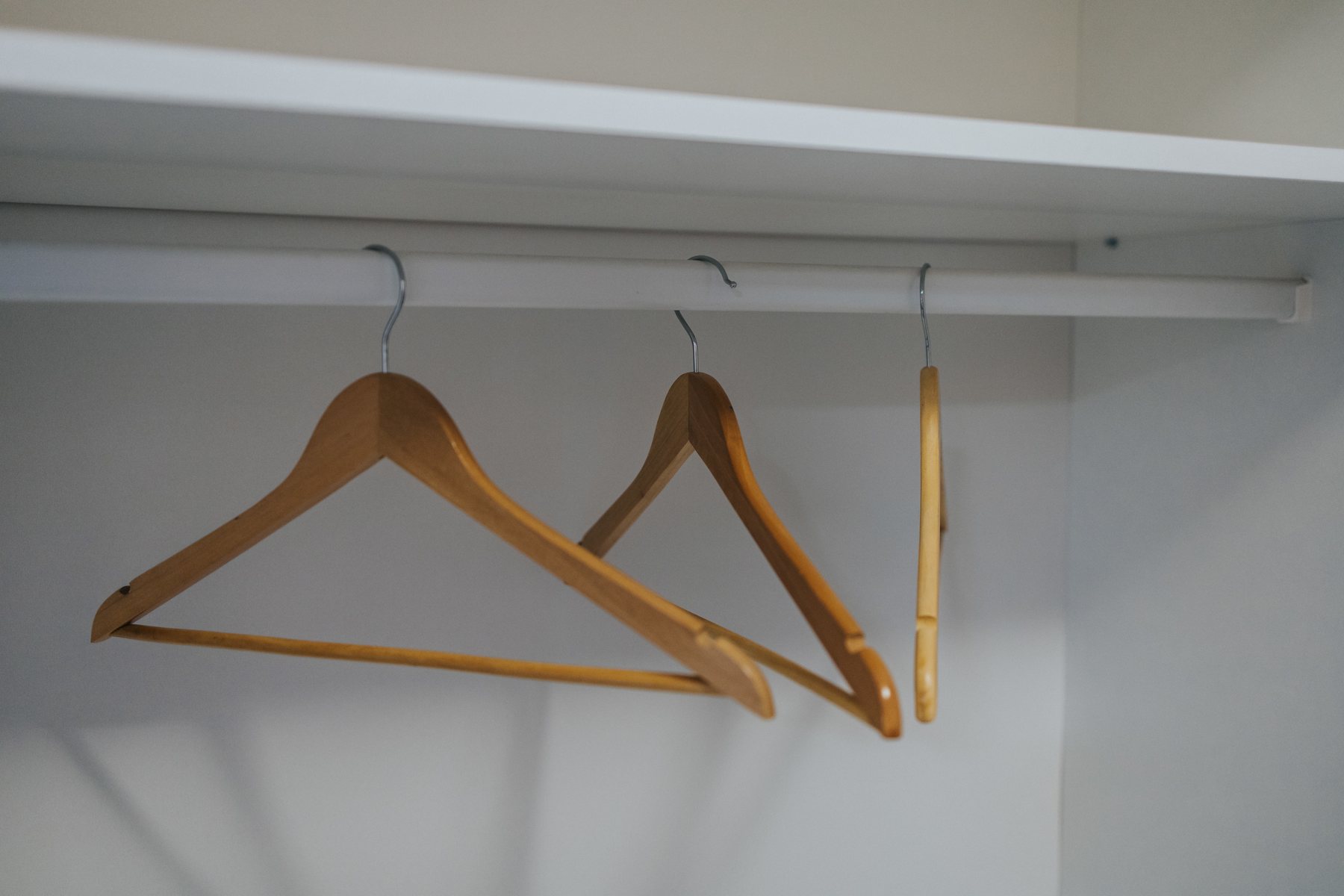
Set each closet rod in a New Orleans home from the clothes it will carry, measured on the hanger. A circular from Oregon State University, reprinted in 1967, gives dresses and coats 63 inches and trousers or blouses 39 to 45. Shelves then fill the wall above or beside those hanging zones, inside the reach of whoever uses the closet.
Last Updated: November 18, 2026
Table of Contents
- How High Should a Closet Rod Be in a New Orleans Home?
- What Hanging Lengths Set Rod Heights in New Orleans Closets?
- Where Should Shelves Sit in a New Orleans Closet?
- How Do Older New Orleans Walls Change Rod and Shelf Mounting?
- Setting Rod Heights That Fit Your Clothes and Your House
- Frequently Asked Questions
A closet rod set a few inches too low leaves coat hems folded on the floor. Set too high, it puts everyday shirts out of easy reach.
At Big Easy Kitchens, we build custom closet storage for homes throughout Greater New Orleans, many of them older houses with awkward closets. Rod and shelf heights get settled early in each of our New Orleans closet remodeling projects.
This page works through single rods, double hanging, shelf placement and reachable storage. It ends with what older walls change about mounting it all.
How High Should a Closet Rod Be in a New Orleans Home?
For a New Orleans home, a closet rod should sit high enough that its longest garment hangs clear of the floor. For coats and dresses, our own sums put the rod above the 63-inch hanging length that Oregon State University gave in a 1967 circular. Shorter clothes can hang from a lower rod.
That circular was reprinted in 1967, and the North Carolina extension guide we also use was reprinted in 1965. Clothing has changed in roughly 60 years, so treat both sets of figures as a starting point.
The 1965 guide describes sturdy, adjustable rods built for clothes of several lengths, and that idea still holds. Hang your longest coat, measure from the top of the hanger hook to the hem, and leave some air beneath it.
What Hanging Lengths Set Rod Heights in New Orleans Closets?
Each rod height follows from the clothes hanging on it, so a typical closet splits into long and short sections. Coats and dresses are the pieces that need the full drop, which is why we settle that split before choosing hardware.
Long Hanging for Coats and Dresses
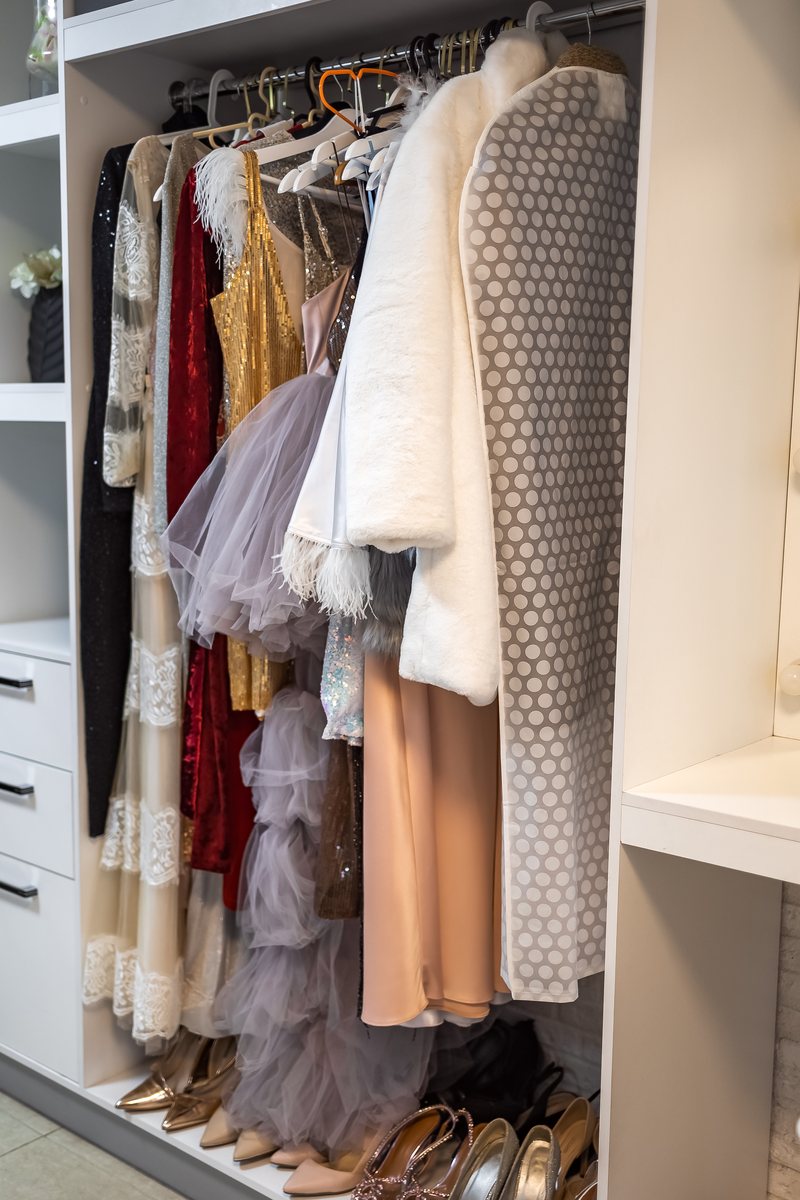
Long coats, dresses and robes need one tall section with a single rod. Oregon State’s 1967 circular gives these garments 63 inches of hanging space.
By our own sums, the rod itself usually has to sit higher than 63 inches. A little clearance under the hems keeps fabric off the floor and out of the dust.
Floor-length gowns and long winter coats can need more than the circular’s average. Measuring the longest piece you own is safer than trusting a number printed in the 1960s.
A long section seldom needs much width. Counting your long pieces tells you how wide to make it.
Double Hanging for Shirts and Trousers
Trousers, suits, blouses and skirts fit a shorter drop, so two rods can stack in one section. Oregon State’s 1967 circular lists a 39 to 45 inch drop for this group.
Adding two of those drops together, we get roughly 78 to 90 inches of wall as a usual range. The lower rod sits at the top of the bottom section, and the upper rod tops the second.
The same circular says a pair of rods saves space, though part of the closet still goes to full-length pieces. That is why a double section usually sits beside a long one.
Once the long pieces have their own bay, the remaining wall can carry two rods.
Mixed Sections in One Closet
Many closets hold both kinds of clothing, so the hanging wall gets divided into tall and short bays. Oregon State’s 1967 circular advises keeping some rod space higher than the rest.
The circular also notes that short clothes on a lower rod leave room for a shelf over them. Where a rod cannot be moved, the circular suggests a chest of drawers beneath the short clothes.
For total length, the circular allows at least four feet of rod for each person. Adjustable rod supports can help when the people using a closet, and their clothes, change over time. Our custom closet design guide shows where these hanging bays fit in a full layout.
Where Should Shelves Sit in a New Orleans Closet?
Shelves in a New Orleans closet usually sit above the top rod, beside a hanging bay, or on a low ledge under short clothes. Each spot suits a different reach, so the table below lists every zone with its height guide and source.
| Zone | Height Guide | Source |
|---|---|---|
| Long-hang rod | Above 63 inches, with clearance under hems | Oregon State circular, 1967 reprint |
| Double-hang rods | Two bays of 39 to 45 inches, about 78 to 90 combined | Our sum from that circular |
| Shelf over the top rod | Enough gap to lift hangers off | Usual trade practice |
| Reachable storage | From 15 up to 48 inches | 2010 ADA Standards (public buildings) |
North Carolina’s 1965 guide adds a low shelf under the usual rod and shelf, away from floor dust. It says a 12-inch shelf holds most hats, folded clothes, shoes and accessories.
Shelves above the top rod need hanger room. Our aging-in-place kitchen guide explains why high shelves often go unused.
The 2010 ADA Standards set the high reach at “48 inches (1220 mm) maximum” and the low reach at 15 inches minimum. The standards’ advisory names clothes rods as storage. The rule covers public buildings, though it can suit a relative at home who uses a wheelchair.
How Do Older New Orleans Walls Change Rod and Shelf Mounting?
Older New Orleans walls change mounting because many have settled out of square over the decades. We plan the fixing for each rod and shelf along with its height, since a good height on a weak fixing will not last.
Walls That Have Moved
Walls in older houses around the city often sit out of square after years of settling. A level rod may then look off beside a nearby shelf. A closet kit in stock sizes may stop short at one end or fail to fit the opening.
Our crew scribes each piece to the wall as it actually stands. Heights are usually taken from a level line, so a sloping floor does not shift the whole layout.
Where the floor slopes, check hem clearance at the low end of the long-hang rod. That end is where a coat is likeliest to touch down.
Fixing Into Older Walls
A closet rod takes weight every day, so the way it fixes into an older wall counts as much as the bracket. Many Creole cottages are framed in heavy timber, which our historic New Orleans kitchen remodeling guide describes in more depth.
North Carolina’s 1965 guide adds that a rod for heavy coats needs a heavier pole than one for light clothes. The long-hang bay often carries the heaviest load in the closet.
Finding solid fixing points before the heights are final can save moving a rod later. A bracket placed where the wall can hold it may sit an inch off the ideal mark.
Shelves That Carry Weight
A shelf over a rod tends to collect heavy bags, boxes and folded stacks. Every shelf and bracket is chosen for the weight it will carry, so it can stay flat for years. On long runs, that means we skip the thinnest melamine boards.
Humidity is part of that choice in this city. Our post on how kitchen cabinet materials handle humidity explains why many local remodels favor plywood boxes for stability.
The crew behind our kitchen cabinet work also builds our closets, so the shelving gets the same joinery standard.
Measuring Before the Build
We measure the opening and list what has to hang, fold or sit on a shelf before drawing anything. Our guide to getting more from kitchen cabinet storage makes the same case for measuring accurately first.
We also note the depth, since North Carolina’s 1965 guide names 24 inches as the minimum for hung clothes. A shallower closet can need a different rod layout.
You approve the drawing, finishes and fittings together, and only then do we order parts. Send us your closet’s measurements to start that plan.
Setting Rod Heights That Fit Your Clothes and Your House
Good rod heights start with your longest garments on their hangers, then stack shorter bays and shelves around them. Older walls in th